
Red As Sin
Fiction by Liam Branaghan


This piece appears in Vol 2: Making Meaning from Spill Your Dreams, a collective publishing group. Experience the inspiration session that led to its creation.
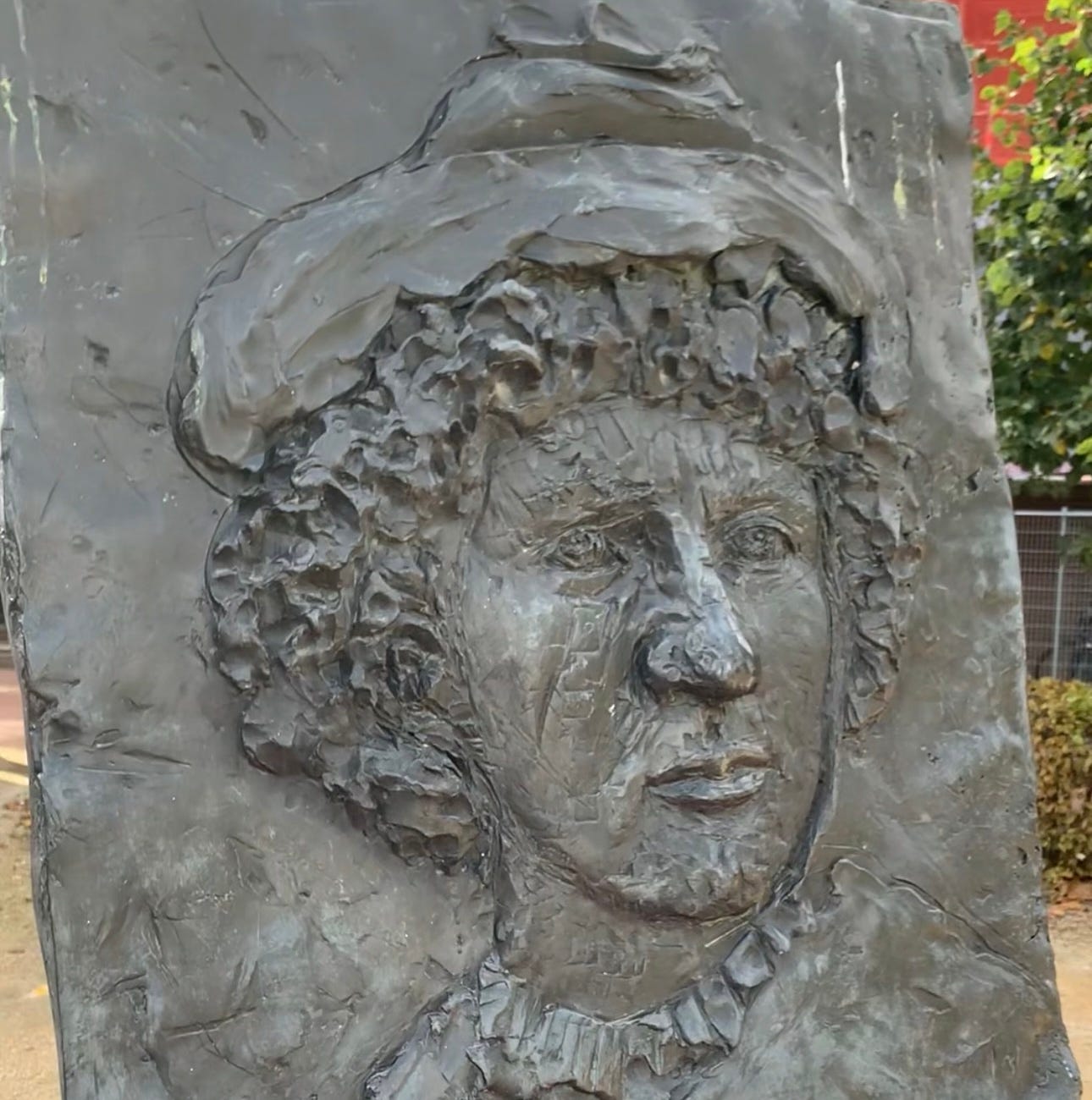
by Liam
The wind scatters fallen pinecones across the courtyard. They pile beneath the statue of young Rembrandt, who focuses the easel in front of him. On the bronze canvas, the worn face of an older Rembrandt confronts him.
“Ah, Rembrandtplaats!” The man in the down jacket pulls a folded map from his pocket and points to the street sign. He searches for the names that had been circled by the hotel receptionist in blue pen. His wife follows, slowing as her husband points towards the young artist in the middle of the square. It’s too windy to be out here. This is probably an important place, he thinks. “Why do you think they’d name this place after Rembrandt?”
“I don’t know, Peter,” the woman says, looking around the square as he inspects the statue. She notices an apartment complex with stick figures chalked to its brick walls, before she walks towards a placard behind the statue. Her husband turns over his map again, and reads the paragraph on Rembrandt’s early life in Leiden.
“Who’d have thought this boy’s paintings would end up all over the world?” Peter says. “First time I ever saw a Rembrandt was on a school trip to the National Gallery of Art. I came home and told my mom I’d seen a real one.”
“The sign says he was born in this square. Can we get a coffee now? I’m getting cold.”
“Was he? Let me have a look,” he says. He hurries to the sign, unbothered by the wind.
“No need, you’ve told me everything else written on the sign before,” she says before folding her arms. She watches him lean his head back to catch the text through the bottom half of his bifocals. His left eye is still pink and swollen.
“You’re right, Susan. That’s the alley he was born in,” he says, pointing to the apartment complex. A sketch of Rembrandt hangs in a resident’s window. “Let’s get that coffee for you, then,” Peter says.
The couple strolls through Leiden’s winding streets, taking in the crooked buildings that lean over them; if the dates on the outside are to be believed, some of the buildings are even older than the country they call home. Even after a few days in the Netherlands, the whole thing just feels intuitive to him. He may not have mastered a word of Dutch, but he recognises something from his mother’s side of the family in the people here. He’s unable to think of a word to describe this feeling.
An elderly woman on an electric bicycle glides past them, with a nonchalance Peter rarely saw back home.
His mom used to talk about the family lineage. Leiden always sounded half-made up. Peter’s roots go back to the English pilgrims who stayed here before leaving for the Americas. His Dad, not wanting to be left out, always added that there was someone Dutch on his side, too. Peter often wondered how life would have been had his ancestors stayed. He feels the itch return in his eye and tries to relieve it with a scratch.
“Don’t do that. You’re only going to make it worse. We should go see a doctor if it’s still irritating you,” Susan says.
Peter glances back at Susan. He doesn’t need to say anything. They both know she’s right.
“We’re not far away, are we?” Susan asks.
“We’re close, I promise.”
They walk side-by-side through the narrowing streets, craning their necks to look up to the church spires in the blue skies above them. Bicycle racks and cafe terraces line the streets ahead. The couple notices a row of students lined up along a bench outside a sports bar; half-empty pitchers of beer and snacks cover the table. A portly man stands up with confidence and makes a declaration to the rest of the group, his voice cracked from shouting and drinking. The group cheers. Peter glances at Susan and raises an eyebrow.
“We should stop in here,” Susan says. She points to an illuminated green cross, the universal symbol for a pharmacy.
“Ah, the trusty old Apotheek. I’m sure some four-time great uncle or other of mine visited,” Peter jokes. He doesn’t hear a response from Susan.
Bells jangle as they enter through the door. “Goedemiddag,” they hear from a strained voice from behind the counter. They both nod and smile as they scan the aisles of the shop for eyedrops, not knowing exactly what they’re looking for. The only products they recognise are hair dyes and sanitary towels.
“What sort of drugstore is this?”
Susan’s question is met by a shrug.
She steps up to the counter and notices the elderly pharmacist sorting small boxes. He wears a white jacket and has a grey moustache as thick as a paintbrush. Peter hangs back, observing the man. He notices the pharmacist’s hunched and wiry frame as he shuffles around.
“Excuse me, sir,” Susan says. She points to her husband’s swollen eye. “He’s in some discomfort. Do you have anything that could help?”
The man coughs. “No, not without a prescription,” the man says in a thick Dutch accent.
“Is there nothing I can buy over the counter?” she asks.
The man groans, before shuffling to the back of the counter. “One moment.”
“I don’t think he understood. I can wait,” says Peter, watching the pharmacist closely while he goes through a battered cardboard box. The pharmacist tosses half the contents aside whilst he searches through the container. The clock on the wall ticks while they wait. Soon enough, the pharmacist reappears. He brings his freckled, veiny hands to the counter with a small vial and a blister pack of tablets.
“Saline solution and paracetamol. If you need anything else, you’ll have to phone the doctor on Monday, or go to the hospital.” He glances at Peter, a brief, neutral look, the sort strangers give. Peter looks back at the pharmacist and tries to read his expression.
“It’s better than nothing, I suppose,” Susan says. She pays for the items with the cash from her purse and thanks the man. As they make their way into the city, the alleyways narrow. An old church, by far the tallest building in this part of the city, towers over them. They both look up at the piercing spire. Peter tries to make sense of how a church like this could have been built by hand, hundreds of years old, still shaping the landscape of Europe. To the back of the building, a sign points to a ramp and a small door that reads: Pieterskerk Cafe.
“Look where we are. I didn’t disappoint, did I?” Peter says, struggling to wink through his swollen eye.
“Let’s not get ahead of ourselves, Peter. We haven’t tasted their coffee yet.”
The couple enters through the ancient doorway. The novelty of needing to crouch to enter is still exciting to them. Another group of students is gathered inside, commandeering a table by the window. They seem more bookish than the student drinkers outside. A girl with cropped hair wearing an oversized sweatshirt reads from a notepad to the group.
Peter and Susan settle at a small table by the door. “What is this place? Where’s the rest of the church?” Susan asks.
Through the gift shop, Peter smiles. “Where else?”
Susan half smiles, half frowns. “But why is there a cafe here? Make sure you get me oat milk in my coffee, please?”
Peter nods back. He goes to the bar and orders the coffee while Susan waits. She studies the room. A small group of tourists wearing baseball caps walks past and deposits coins into a box, before heading deeper into the building. A sign reads, “Paying guests in the church only.” Susan notices a wooden board with the names and dates of what she presumes are the trustees of the church, and looks over the cafe. She searches for Peter’s mother’s surname, but can’t find it. She arranges the colour of her blouse while she waits.
“One oat milk cappuccino,” says Peter, sliding the wide-brimmed cup across the table. “Isn’t this something? Nice, they’ve got the cafe here, too. I didn’t feel like sitting out there with that bunch,” he says. “You know, I think the waitress was looking at me funny.”
“It’s probably your eye,” Susan says. Peter stays quiet and sips his coffee.
“There’s a museum here, you know, for the pilgrims. We should check it out after we’ve been inside the church,” Peter says.
“Mmhmm,” Susan replies, in no rush to go anywhere. They sit, without saying a word, and try to soak in the sense of being here.
After finishing up, the couple pay for their coffee and buy an entry ticket into the church from the waitress. They walk through the small door, past the modern bathroom, into a cavernous chapel. The scale of the building becomes apparent from the inside. Peter stands still, looking up to take in the stained glass and the wooden ceiling. Susan notices the way he cranes his neck back. She can imagine him as an elderly man; they’re not that old, not yet, she thinks.
“Five years the pilgrims lived here before they could eventually make it to America, five years! I wonder how many of them ended up staying in Leiden,” Peter says, walking around. He isn’t sure what he’d expected to feel being in the church, but he’d expected something more. He examines the brickwork, trying to find any ornate details of interest. While he slowly paces the church, Susan takes in the kaleidoscopic stained glass above, before she notices a group of fellow tourists.
“Ha, look,” Peter points to the baseball caps they’re wearing, and walks straight towards them. “Go Buckeyes!”
“Well, I’ll be damned. Small world!” a man in a red hoodie says. The group, many of them several years older than Peter and Susan, walk towards the couple.
“We can’t go anywhere without escaping Ohio,” a woman with blue-tinted glasses says. “So what brings you all the way over to Holland?”
“Peter’s a descendant of one of the pilgrims who stopped here,” Susan says.
“How awesome,” the baseball cap-wearing tourists nod and repeat in unison.
“Me too!” says an elderly man carrying trekking sticks, with a proud smile. “I can see all this family history is making your eyes water, fella!” He laughs.
Peter nods, but doesn’t return the smile. He feels the group’s stare.
“He has an eye infection. Look what they gave us at the drugstore,” Susan shows the saline solution she’d kept in her pocket. “Tylenol and salt water!”
“Well, today might be your lucky day,” the woman in the blue glasses says.
A woman with a blond perm at the back of the group steps forward. “I might have something for you.” She rustles through her purse while the group watches.
“She has something for everything, that woman,” the man with the sticks says.
“Here. It’s in date—just.” She hands Peter a small vial with a red label. “Paul gets sore eyes, don’t you?” she says, pointing to a bald man at the back. “Every Sunday afternoon, he watches the TV, then falls asleep on the couch—with his contact lenses in. He wakes up and wonders why his eyes are as red as sin.” The man turns away, suddenly shy. “Here, have them. We fly back on Tuesday.”
“Why, thank you. Are you sure?” Peter says. “My good Samaritan.”
The group laughs, except for the bald man, who turns away.
“Nice meeting y’all. Safe travels and enjoy the Netherlands,” Peter says.
“What kind people,” Susan says. “Did you see that window up there? Incredible.”
Peter rubs his eye again, and Susan rests a hand on his arm.
They walk to the stained glass window. The door closes behind the tourists, and the room dims.
Spill Your Dreams, Vol. 2

 |
|